
The Celts
The celts arrived in Ireland about 500 BC. They moved over to Ireland from Europe. They brought knowledge and iron with them, so that they could make stronger and sharper tools and weapons than before.
Brehon Law
A set of laws was devised in ancient Ireland, which is called "Brehon Law". The Laws were passd dowen orally for centuries. They were first written down in the 5th century. Maybe the patron saint of Ireland Saint Patrick was involved in the process of writing the laws down.
The name "Brehon" comes from the Irish word "judge". Therefore the Brehons were the lawyers of old society in Ireland. The Irish law was pretty complex and difficult so the Brehons were respected by the rulers and landowner.
Brehon Law regulated the society and the several rights and privilegs of the different ranks of society. The most amazing point in the Brehon Law is that women were equal to men!
Ogham
The early Irish language and later the Old Irish language were mostly discovered on stone monuments, but there are hardly more than 400 surviving orthodox inscriptions.
The early medieval alphabet is called “Ogham" or also "Celtic Tree Alphabet". It was used in the 5th and the 6th century.
The letter names are interpreted as names of trees or shrubs in manuscript tradition. The stone monuments are called "Ogham stones".
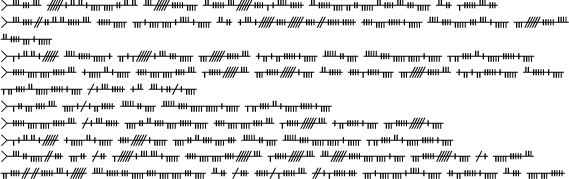
The next paragraphs should illustrate the "Ogham". Information from: http://www.omniglot.com/writing/ogham.htm
An Old Irish Joke in Primtive Irish (translation by David Stifter)
Transliteration
Tengwās īwerijonākā
Tut raddassodd trīs dītrebākī dīslondetun do bitū.
Tēgoddit in wāssākan do atareregiyī esyan kenutan writ dēwan.
Bāddar kina labarātun writ alaliyan qos qennan blēdaniyās.
Issit andan esset bīrt wiras dī ēbis writ alaliyan diyas blēdniyas: “mati ad tāyomas.”
Bowet samali qos qennan blēdaniyās.
“Issit mati sodesin,” esset bīrt aliyas uiras.
Bāddar andan ēran sodesū qos qennan blēdaniyās.
“Tongū wo mō brattan,” esset bīrt trissas uiras, “ma nīt lēggītar kiyunessus do mū, imbit gabiyū wāssākan oliyan dū swi.”Old Irish (Sengoídelc) version
Tríar manach do·rat díultad dont ṡaegul.
Tíagait i fásach do aithrigi a peccad fri día.
Bátar cen labrad fri araile co cenn blíadnae.
Is and as·bert fer diib fri araile dia blíadnae, “Maith at·taam,” olse.
Amein co cenn blíadnae.
“Is maith ón,” ol in indara fer.
Bátar and íar suidiu co cenn blíadnae.
“Toingim fom aibit,” ol in tres fer, “mani·léicthe ciúnas dom co n-imgéb in fásach uile dúib.”Modern Irish (Gaeilge) version (by Dennis King)
Triúr manach a thug diúltú don saol.
Téann siad ins an fhásach chun aithrí a dhéanamh ina gcuid peacaí roimh Dhia.
Bhí siad gan labhairt lena chéile go ceann bliana.
Ansin dúirt fear díobh le fear eile bliain amháin ina dhiaidh sin, “Táimid go maith,” ar seisean.
Mar sin go ceann bliana.
“Is maith go deimhin,” arsa an dara fear.
Bhí siad ann ina dhiaidh sin go ceann bliana.
“Dar m’aibíd,” arsa an treas fear, “mura ligeann sibh ciúnas dom fágfaidh mé an fásach uile daoibh!”English version (by Dennis King)
Three holy men turned their back on the world.
They went into the wilderness to atone for their sins before God.
They did not speak to one another for a year.
At the end of the year, one of them spoke up and said, "We’re doing well."
Another year went by the same way.
"Yes we are," said the next man.
And so another year went by.
"I swear by my smock," said the third man, "if you two won’t be still I’m going to leave you here in the wilderness!


No comments:
Post a Comment